
Most of the sustainability risk in Liberian natural rubber sits with smallholders, not estates. Small farms supply a large share of the cup lump that becomes TSR20, often through intermediaries, and many of those farms have never been mapped. Making that rubber deforestation-free and traceable means mapping each farm, checking it against forest cover at the end of 2020, recording who sells what, and keeping traced rubber separate all the way to the container.
This guide explains where the risks are and what buyers can verify. For how this fits the EU rules, see our EUDR page.
How rubber reaches the factory
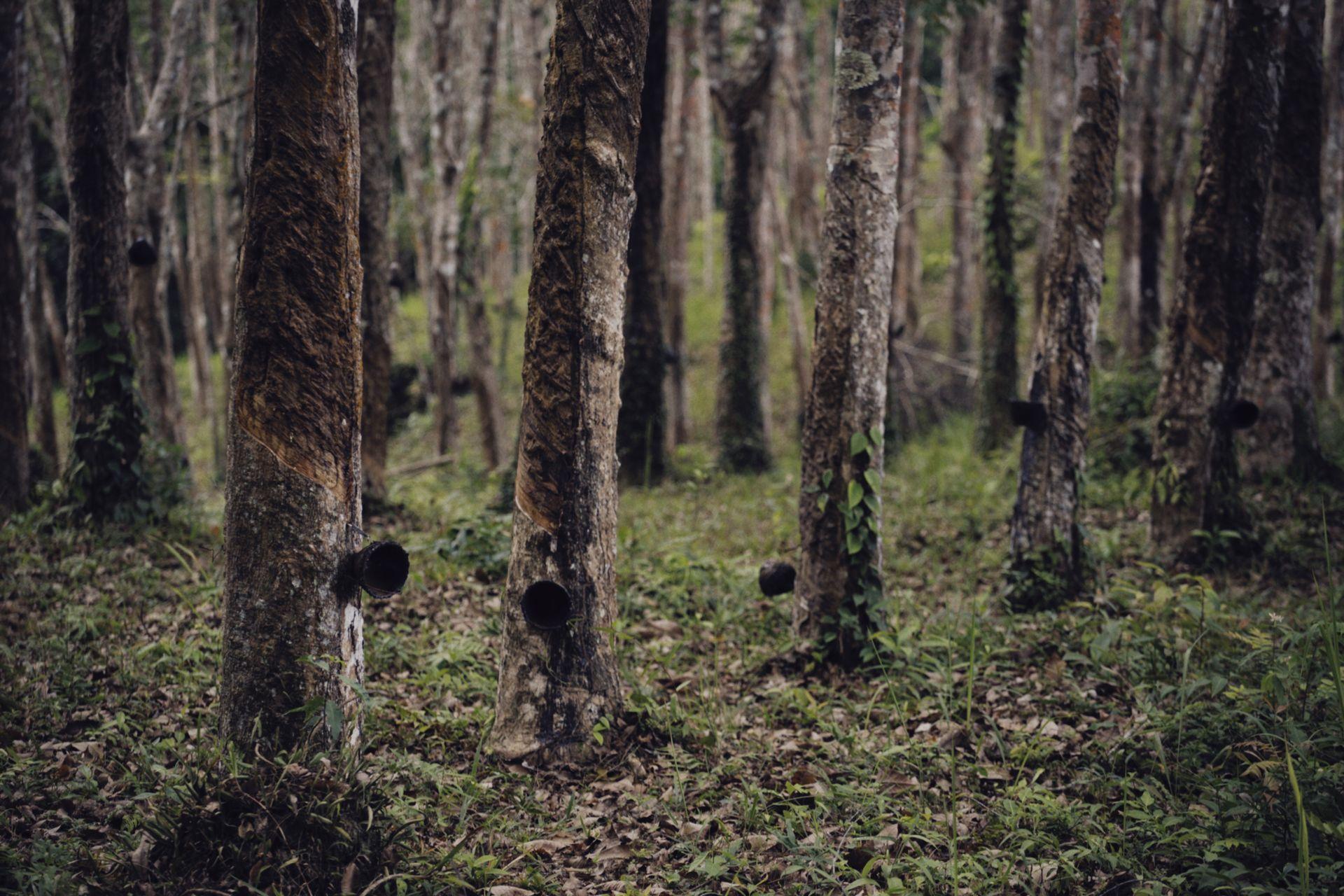
A typical smallholder taps a few hectares of trees, collects cup lump and sells it every week or two. The buyer may be a local agent, a collection centre or a dealer with a truck. By the time rubber reaches a processing factory, it may have passed through two or three hands and been mixed with rubber from many farms.
For a buyer abroad, each of those steps is a point where untraced rubber can enter.
The main risks
| Risk | Why it matters |
|---|---|
| Unmapped farms | No geolocation, so no EUDR compliance |
| Mixing at collection | Traced and untraced rubber become one lot |
| Recent clearing | New plantings on land that was forest in 2020 fail the cut-off |
| Land tenure | Customary land rights can make legality evidence hard to obtain |
| Labour | Smallholder farms can involve family labour, including children, which buyers must assess |
Liberia holds a large share of the remaining Upper Guinean forest. That is why the deforestation check matters, even for farms that look established.
What a credible programme looks like
Mapping and registration
Field teams visit each farm, record its boundary or centre point, note the farmer's details and the area under rubber, and register the farm as a supplier. Farms over 4 hectares are mapped as polygons. Farmers get a supplier ID that follows their rubber.
Deforestation screening
Each mapped plot is checked against forest cover data for 31 December 2020. Plots that overlap forest cleared after that date are excluded from EU supply. Borderline cases are checked on the ground.
Segregated collection
Rubber from registered farms is weighed and recorded against the farmer's ID at collection, transported separately, and processed in identified batches. That is the link between the map and the bale.
Legality and social checks
Land use rights are recorded, using customary tenure documents where formal titles do not exist. Liberia's Land Rights Act of 2018 recognises customary land ownership, which affects what legality evidence looks like. Labour practices are checked, including the use of child labour.
Benefits for farmers
Traceability takes work from farmers too. A programme that only takes data rarely lasts. Programmes that work tend to offer something back: faster payment, a stable buyer, training on tapping and cup lump quality, or a premium for clean, traceable rubber. Better handling at farm level also improves dirt content and PRI in the finished TSR20. See TSR20 specifications explained.
Many Liberian rubber trees are old, and replanting on existing farmland is ongoing. Replanting on land that was already under rubber does not conflict with the EUDR cut-off date, but new planting on land that was forest at the end of 2020 does. The date and location of each planting therefore matter as much as the farm itself.
What buyers can verify
- The data itself. Ask for a sample data package and load it into a map. See geolocation and traceability data.
- Coverage. Ask what share of total supply comes from mapped farms, and how much of that goes to EU contracts.
- Segregation. Ask to see collection records that link farmer IDs to factory batches.
- Independent checks. Ask whether any third party has reviewed the programme.
- Grievances. Ask how farmers or communities can raise complaints.
A supplier should not identify individual farms, factories or locations publicly, but should share the data needed for due diligence with buyers under contract. We are not yet EUDR compliant and are building these steps into our own supply; see our EUDR status.
How Liberia compares
Liberian rubber faces the same smallholder questions as rubber from Côte d'Ivoire or Southeast Asia, with a different mix of estates, farms and forest. Our comparison of rubber origins covers this in more detail. For importer obligations, see EUDR due diligence for rubber.